
A maritime-sector company operating in the UAE engaged Nathan HR to manage its monthly payroll processes. The requirement centred on consistent payroll execution, accuracy, confidential handling of employee data, statutory compliance support and access to dedicated local payroll expertise.
For UAE mainland payroll, the monthly run sits within a wider regulatory framework. Employers registered with the Ministry of Human Resources and Emiratisation (MOHRE) pay wages through the Wage Protection System (WPS), and payroll records must support each employee’s end-of-service entitlements. How these requirements apply depends on the employer, the employment framework and the agreed payroll scope.
The Client’s Payroll Requirement
The client is a UAE maritime services business, and we manage the monthly payroll processes for its UAE operations. Because the business operates in a regulated industry, the engagement is built around five requirements:
consistent payroll execution every month
accurate payroll calculations and outputs
confidential handling of payroll and employee information
support with statutory payroll compliance
dedicated local payroll support
The client sought a trusted payroll partner able to meet these requirements every month.
Managing Monthly Payroll
For this client, we manage monthly payroll processes and support consistent execution, accuracy, confidentiality and statutory compliance.
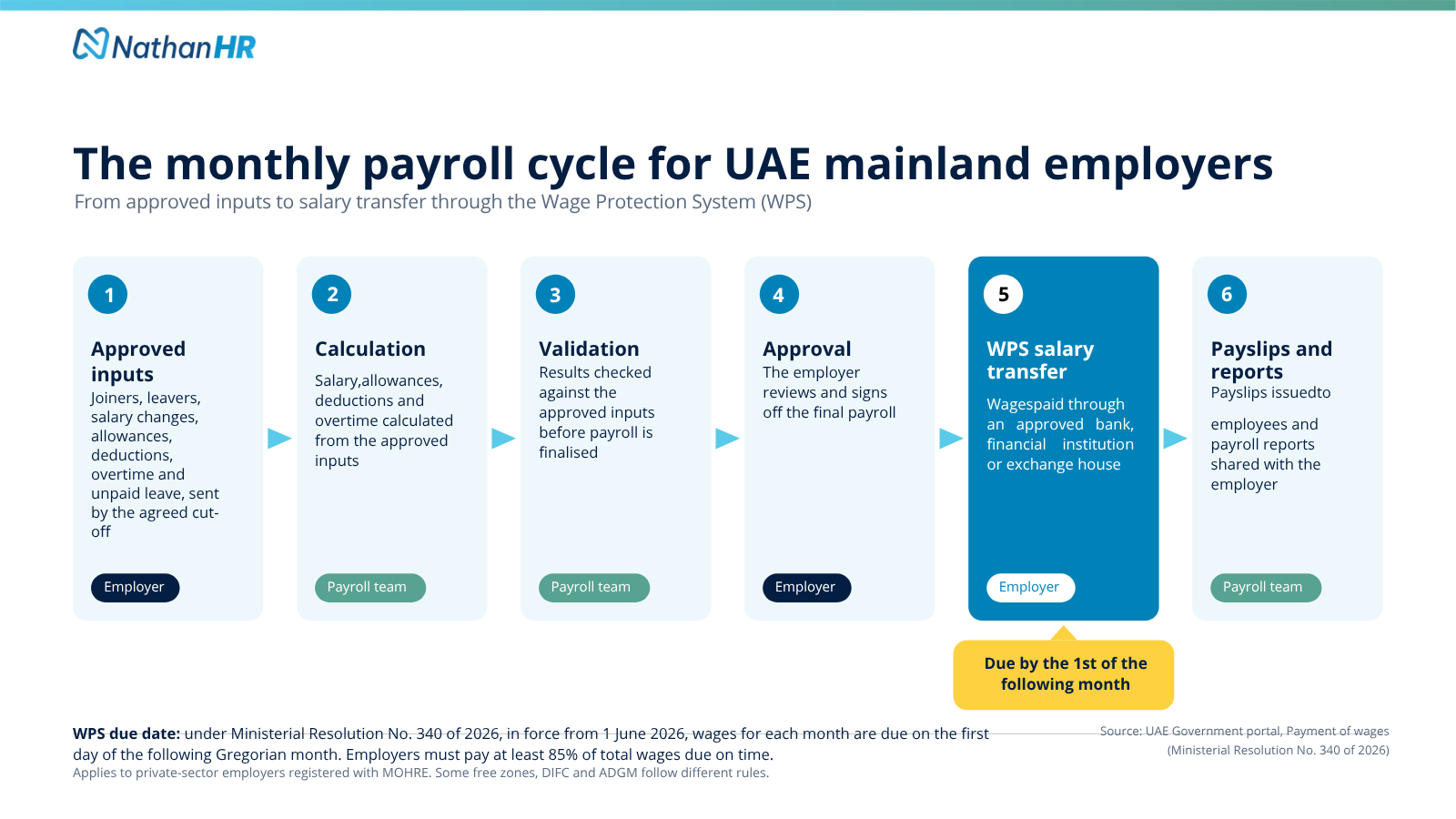
More generally, our managed payroll services in the UAE follow a fixed monthly sequence for UAE mainland payroll: we receive approved inputs, review employee changes, calculate pay, validate the results, obtain client approval, then issue payslips and reports.
The table below describes general payroll administration for a mainland employer. It is not a list of services delivered to the client in this case study.
Payroll area | What it can cover |
|---|---|
Payroll inputs | Approved employee and salary changes |
Calculations | Salary, allowances, deductions and overtime |
Validation | Review before payroll is finalised |
WPS | Wage-payment requirements where applicable |
End of service | Final payroll calculations, depending on scope |
Reporting | Payslips and payroll reports |
Payroll Inputs and Approvals
Monthly payroll depends on complete, approved information reaching the payroll team before the agreed cut-off. Employers provide:
approved employee master data
new joiners and leavers
salary changes
allowances and deductions
overtime hours
unpaid leave
variable pay, including bonuses or commissions where relevant
any other approved employee changes
The employer approves the inputs and the final payroll; the payroll provider calculates, validates and reports. Late or unapproved inputs lead to corrections in a later cycle, so the payroll timetable sets a cut-off for inputs, a validation window and a sign-off deadline. Under WPS, that timetable must also leave time to fund and transfer wages before the first of the month.
WPS for UAE Mainland Payroll
The Wage Protection System is the UAE’s electronic salary-transfer system for the private sector. Developed by the Central Bank of the UAE, it routes wages through approved banks, financial institutions and exchange houses and gives MOHRE a record of whether wages are paid in full and on time.
Mainland companies are subject to WPS. Under Federal Decree-Law No. 33 of 2021 and its implementing resolutions, private-sector establishments registered with MOHRE must pay wages on the due date through WPS or another MOHRE-approved payment system.
The rules changed on 1 June 2026. Ministerial Resolution No. 340 of 2026 replaced Resolution No. 598 of 2022 and made the first day of each Gregorian month the due date for the previous month’s wages. Employers must transfer at least 85 per cent of total wages due on time, and the resolution sets gradual measures for late payment, including warnings and suspension of new work permits. Where payroll administration is outsourced, the employer remains responsible for paying wages on time.
Free-zone and financial-centre employers follow different rules. Some free zones apply their own wage-payment arrangements, and DIFC and ADGM have separate employment legislation. This section applies to MOHRE-registered mainland employers only.
Depending on the agreed scope, our WPS payroll support includes preparing WPS-compliant salary files from validated payroll data. We also support non-WPS payroll for employers not covered by MOHRE WPS. If your payroll calendar was built around the previous grace period, review your input cut-offs and funding dates against the new due date.
End-of-Service Administration
End-of-service administration is the payroll work that produces an employee’s final settlement. For foreign full-time employees in the mainland private sector, Article 51 of the UAE Labour Law sets the gratuity rules:
entitlement begins after one year of continuous service
the gratuity is 21 days’ basic wage for each of the first five years and 30 days’ basic wage for each year after that
it is calculated on the last basic wage, not total pay
days of unpaid absence are excluded from the service period
the total gratuity cannot exceed two years’ wages
end-of-service entitlements must be paid within 14 days of the contract ending
These rules do not apply identically to every employee. End-of-service benefits for UAE nationals follow pensions and social security legislation. Part-time and other work arrangements have their own calculation basis. Employers that subscribe to the optional alternative end-of-service savings scheme make contributions in place of the standard gratuity for covered periods. The contract, service history and circumstances of termination also affect the final settlement.
In payroll terms, a final settlement can bring together:
final salary to the last working day
the end-of-service benefit calculation
payment for accrued annual leave where due
other payroll balances owed to or by the employee
deductions the law permits
payroll records and supporting calculations
Depending on the agreed scope, our managed payroll service includes end-of-service benefit calculations based on the employee’s contract, basic wage and service records.
Payroll Reporting and Security
Confidentiality was a core requirement for the maritime client. We handle its payroll and employee data securely, maintain accurate payroll records and run its monthly payroll as a controlled, consistent process. The client works with dedicated local payroll support throughout.
Across our payroll clients, processing runs on Payroll Central, our in-house payroll technology. Employees can access their payslips online and through mobile access, and payroll reports are prepared in the format agreed with each client. Every client has a dedicated HR Business Partner supported by our local payroll specialists.
What Changed for the Client
With monthly payroll managed by Nathan HR, the maritime client has:
streamlined payroll administration
more consistent payroll execution from month to month
reliable payroll service delivery
reduced operational risk in its payroll process
a positive payroll experience for its employees
The arrangement also allows the client to concentrate on its core maritime business. Outsourcing has reduced operational risk without eliminating it, since payroll accuracy still depends on complete, timely inputs.
Switching Payroll Providers
Switching to Nathan HR follows a structured onboarding sequence. The steps below describe our general process; the depth of each step depends on payroll complexity.
Requirements review. We confirm the payroll scope, jurisdiction, pay cycle, reporting needs and whether WPS or non-WPS support is required.
Employee-data review. We check employee master data for completeness and consistency.
Review of the existing payroll process. We map current inputs, approvals, cut-offs and outputs.
System configuration. We set up pay elements, allowances, deductions and rules in Payroll Central.
Validation. We test calculations against historic results.
Shadow payroll, depending on complexity. We run payroll in parallel with the existing process and compare the outputs before go-live.
Agreed go-live. The first live cycle runs on the agreed date.
We require three months of payroll history during onboarding. It lets us reconcile our calculations against previous results, confirm recurring allowances and deductions, and identify irregular items such as overtime or variable pay. For a fuller overview, see how payroll outsourcing works in the UAE.
What Employers Should Prepare
Before switching payroll providers, gather the following:
employee master data, including contract terms
salary structures, with basic salary separated from allowances
three months of payroll history
recurring allowances, deductions and overtime rules
leave balances and unpaid leave records
joiners and leavers in progress
named payroll approvers and agreed deadlines
WPS details where applicable, such as the employer’s WPS agent
Separating basic salary from allowances is essential for end-of-service records, because the statutory gratuity is calculated on basic wage.
Once these documents are ready, request a payroll scope review and our team will confirm the scope, onboarding steps and go-live date for your business.
How Nathan HR Supports Payroll
Depending on the agreed scope, our payroll services in the UAE can include:
managed payroll processing
salary, allowance, deduction and overtime calculations
payslip generation
payroll reporting
WPS or non-WPS payroll support
end-of-service benefit calculations
compliance support in line with applicable labour law, WPS and statutory requirements
In 2025, we processed more than AED 1.5 billion in payroll. We apply payroll rules according to each client’s operating jurisdiction and agreed scope, and payroll can be combined with our HR outsourcing services.
Manage UAE Payroll With Nathan HR
Need support with monthly payroll for your UAE workforce? Request a payroll scope review and share your employee numbers, operating jurisdiction, current payroll process and reporting requirements. Our payroll team will define the appropriate scope for your managed payroll service.