
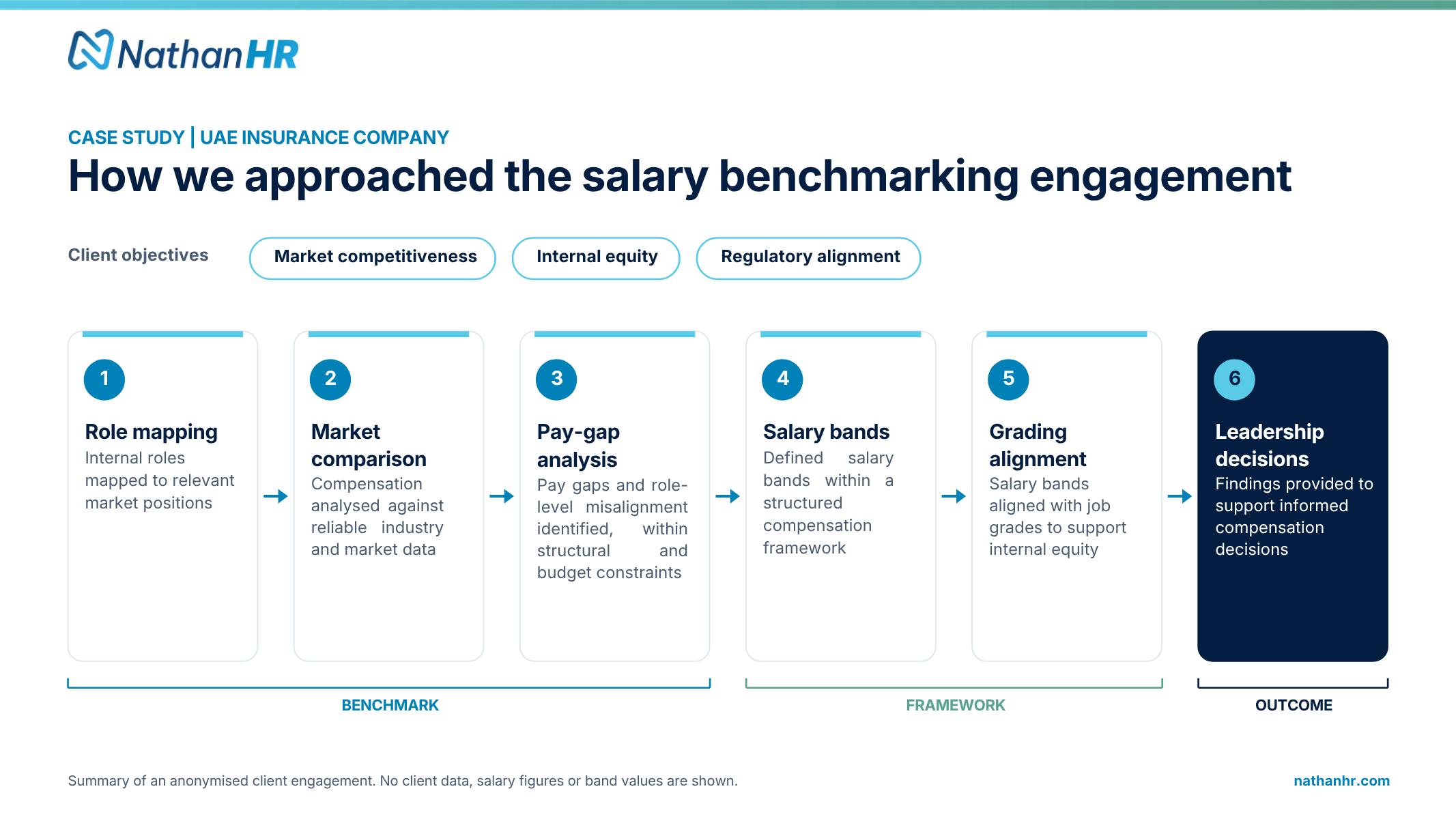
A UAE insurance company engaged us to review and strengthen its salary benchmarking and compensation framework. The outcome was a structured compensation framework with defined salary bands and grading alignment, built on market data and designed to support leadership decisions on pay.
Below, we set out each stage of the engagement, followed by when salary benchmarking in the UAE is useful, what to prepare and how we run benchmarking projects.
The Client’s Compensation Requirement
The client wanted its compensation framework to deliver three objectives:
Market competitiveness: compensation aligned with relevant market positions.
Internal equity: consistent pay for roles of comparable level within the organisation.
Regulatory alignment: a framework consistent with the regulatory requirements that apply to the business.
The scope covered both the salary benchmarking exercise and the compensation framework, so the benchmarking findings formed the basis of the structure we developed.
Mapping Roles to the UAE Market
We mapped the client’s internal roles to relevant market positions. Every comparison in a compensation benchmarking exercise depends on this match: a role compared with the wrong market position produces a misleading result, however reliable the data.
Comparing Market Compensation
We analysed the client’s compensation against reliable industry and market data.
For broader context on pay in the UAE, our 2026 salary benchmarking report covers salary expectations, employer salary predictions, top-valued benefits and in-demand jobs. It is a general salary survey resource and is not presented here as the dataset for this engagement.
Identifying Pay Gaps
The comparison identified:
pay gaps against relevant market positions
role-level misalignments
areas of the compensation structure requiring adjustment
We assessed these findings against the client’s organisational structure and budget constraints.
Building Salary Bands in the UAE
A salary band is the pay range set for a group of roles at the same level. In any salary structure, bands give HR and finance a common reference for job offers, pay reviews and promotions.
Based on the findings, we developed a structured compensation framework that included defined salary bands. The framework was designed to support transparent, consistent and scalable compensation practices.
Job Grading and Pay Alignment
Grading alignment formed part of the framework. Linking salary bands to job grades places roles of comparable level within the same pay range. This is how a compensation framework supports internal equity, one of the client’s three objectives.
What Changed for the Client
The engagement gave the client:
a market-aligned compensation structure
defined salary bands and grading alignment to support internal equity
stronger salary governance through a structured framework
findings for leadership to support informed compensation decisions, including decisions on talent attraction and retention
As the engagement is confidential, we do not publish salary values, band figures or pay-gap percentages from this work.
When Benchmarking Is Useful
In our benchmarking work, salary benchmarking is useful when you are:
building or revising a job grading structure and need market data to set pay ranges
reviewing whether your compensation framework still supports market competitiveness and internal equity
recruiting for specialist roles in high demand in the regional talent market
operating in the Dubai International Financial Centre or another free zone, where salary benchmarking in Dubai calls for a narrower peer group than the wider UAE market
aligning pay across several business units or sectors
giving hiring managers salary references for specific job profiles
running a wider HR review that covers grading, policies or workforce planning
What Employers Should Prepare
Benchmarking draws on your internal compensation and benefits data for your UAE roles. Based on the stages above, the following information helps:
Input | What it supports |
|---|---|
Organisation chart and reporting lines | Role mapping and grading alignment |
Job descriptions or role profiles | Accurate role mapping |
Current compensation by role, including fixed pay, allowances, variable pay and benefits | Accurate comparison with market data |
Existing grades or salary ranges, if any | Assessing what the new framework replaces or refines |
Budget parameters for pay adjustments | Prioritising which gaps to address |
Your view of the competitor or peer group | Defining the relevant market comparison |
Where job descriptions are missing or out of date, we can develop them as part of the engagement. All compensation and employee data you share is handled under strict confidentiality.
If you are assessing your own pay structure, our team can review what you have and scope a project around it. Book a free consultation on compensation benchmarking in the UAE.
How Nathan HR Approaches Benchmarking
Salary benchmarking sits within our compensation and reward management services, supported by more than 10 years of HR consulting experience in the UAE and GCC. We have run salary benchmarking for employers in technology, higher education, reinsurance, hospitality and consumer goods. For benchmarking engagements, our approach can include:
Discovery and assessment: reviewing your current compensation, grades, structure and priorities.
Role mapping: matching your internal roles to relevant market positions, and defining the peer group by industry and geography where relevant.
Market comparison: analysing fixed pay and, where in scope, variable pay and benefits, taking account of factors such as years of experience for each position.
Gap analysis: identifying pay gaps and role-level misalignment within your structural and budget constraints.
Framework design: developing salary bands and aligning them with job grades.
Implementation and ongoing support: helping your team apply the framework, with updates as the market and your organisation change.
Timelines depend on scope. A focused salary benchmarking project can take a few weeks, while a full compensation framework or grading redesign runs over several months. We agree milestones with you before work begins.
Book a Benchmarking Consultation
If you are reviewing pay competitiveness, building salary bands or aligning pay with grades, book a free consultation with our team about salary benchmarking and compensation consulting. We treat all client information with strict confidentiality and provide detailed pricing upfront.
Not ready to book a consultation? Start with the Nathan HR 2026 salary report for current UAE salary and hiring trends.