Cost Per Hire
What Is Cost Per Hire?
Cost per hire (CPH) is a key recruitment metric used in HR management that calculates the total expense incurred to hire a new employee. It includes both internal and external recruitment costs, from advertising and recruiter fees to time spent by internal teams and onboarding resources.
In simple terms, cost per hire helps you understand the real investment made to bring new talent into your organization. It allows HR teams to measure recruitment efficiency and compare results across departments, roles, or time periods.
This metric is also used to set hiring budgets, assess the performance of recruitment channels, and justify investments in HR technology or talent acquisition strategies.
Why Cost Per Hire Matters
Cost per hire plays a vital role in workforce planning and talent acquisition strategy. Here’s why it matters:
Budgeting: Knowing how much it costs to fill a role allows you to set accurate hiring budgets and forecast future recruitment expenses.
Hiring efficiency: CPH helps you identify which recruitment channels and tactics are delivering the best value for money.
ROI measurement: By comparing the cost with the quality, performance, and retention of hires, you can evaluate the ROI of your recruitment process.
Benchmarking: Understanding your CPH helps you stay competitive within your industry and region by comparing your performance with other companies of similar size.
Strategic decision-making: Leadership teams often rely on this metric when deciding whether to scale internal recruitment efforts or outsource hiring to specialized partners.
What’s Included in Cost Per Hire?
To get a complete and accurate picture, both internal and external recruitment costs should be factored into the cost per hire calculation. These typically include:
Internal Costs:
- Salaries and benefits of in-house recruiters and HR personnel
- Time spent by hiring managers and teams in interviews and screening
- Referral program costs
- Internal recruitment software and platforms (e.g., ATS, HRIS)
- Employer branding content and assets
External Costs:
- Recruitment agency or headhunter fees
- Paid job board listings and ads
- Costs associated with career fairs or recruitment events
- Pre-employment assessments, background checks, and medical tests
- Travel, accommodation, or relocation expenses for candidates
Cost Per Hire Formula
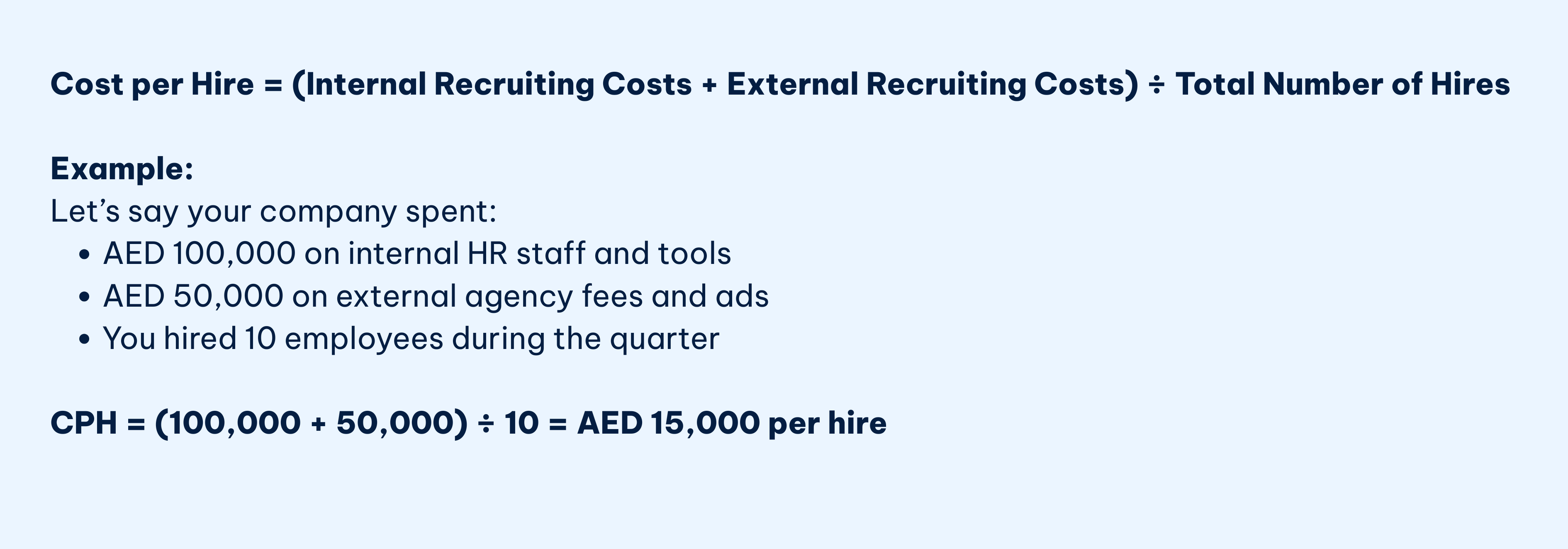
The commonly accepted formula is:
What Is a Good Benchmark?
According to the Society for Human Resource Management (SHRM), the global average cost per hire is around USD 4,700.
However, benchmarks differ significantly depending on the industry, job function, and hiring location.
In the UAE, several additional costs must be factored in, such as:
- Visa sponsorship and residency costs
- Medical testing and Emirates ID processing
- Relocation and travel expenses for international hires
- Sponsorship documentation and PRO service fees
For companies hiring expats or technical talent, it’s not unusual for cost per hire in the UAE to range between AED 15,000 and AED 30,000.
How to Reduce Cost Per Hire Without Compromising Quality
Lowering your cost per hire doesn’t mean cutting corners. It means finding smart, data-driven ways to improve the efficiency of your hiring process.
Here are some proven strategies:
- Write compelling, accurate job descriptions: A well-written job ad attracts better candidates, reduces irrelevant applications, and shortens time-to-hire.
- Use an applicant tracking system (ATS): Automating repetitive tasks and centralizing communication improves speed and consistency.
- Leverage employee referrals: Employees often refer great candidates and at a much lower cost than external sources.
- Build a long-term talent pipeline: Engage passive candidates and keep warm leads for future openings.
- Enhance your employer brand: A strong brand can attract top candidates without heavy advertising spend.
- Invest in recruitment analytics: Use data to understand which sources give you the best results at the lowest cost.
- Work with recruitment process outsourcing (RPO) or staffing agencies: For growing businesses, this can cut cost per hire significantly while improving quality.
How to Track and Improve Cost Per Hire
Here are tips to ensure your tracking is accurate and actionable:
- Break down CPH by department, job level, and source.
- Monitor time-to-hire in parallel to understand the relationship between speed and cost.
- Use CPH alongside other metrics like quality of hire, offer acceptance rate, and new hire retention.
- Review your recruitment spend quarterly and reallocate budget based on results.
Common Mistakes to Avoid
Not including all costs: Forgetting to factor in hidden expenses like manager interview time or onboarding can skew your results.
Using outdated benchmarks: Your benchmark should reflect your current hiring market, especially in a fast-evolving region like the UAE.
Focusing only on cost: A low cost per hire is not always a good thing if it results in poor-quality hires and high turnover.
Final Thoughts
Cost per hire is more than a financial figure, it’s a window into the health and effectiveness of your hiring strategy.
Understanding this number allows businesses in the UAE to hire smarter, plan better, and remain competitive in attracting top talent.
As the talent market becomes more complex and competitive, tracking cost per hire along with quality of hire and time-to-hire, helps HR leaders strike the right balance between cost, speed, and talent quality.

FAQs About Cost Per Hire
What is cost per hire in HR?
Cost per hire is a recruiting metric that measures the total cost incurred to hire one employee. It includes both internal and external recruitment costs divided by the number of hires.
What is a good cost per hire benchmark?
The global average is USD 4,700, but in the UAE, it’s often higher due to visa, relocation, and compliance costs.
Does cost per hire include salary?
No. It only includes costs related to the hiring process, not the employee’s compensation or benefits.
How can you reduce cost per hire?
Streamline hiring workflows, improve job ads, use automation tools, build a talent pipeline, and partner with efficient HR providers.
What tools can help track or lower cost per hire?
Applicant tracking systems (ATS), recruitment analytics software, HR dashboards, and outsourced HR partners.
What is the importance of cost per hire?
It helps HR teams measure recruitment effectiveness, manage budgets, and improve hiring strategy.
Can working with a recruitment agency reduce cost per hire?
Yes, if the agency provides speed, quality, and access to better-fit candidates, it can lower both time-to-hire and overall hiring costs.