
Payroll outsourcing allows an employer to appoint a specialist provider to perform agreed payroll administration while the employer retains responsibility for employment decisions, payroll inputs, approvals and funding.
Nathan HR combines managed payroll services with Payroll Central, our payroll platform. Our current published service covers WPS and non-WPS salary processing, claims and reimbursements, end-of-service benefit processing, bilingual payslips, payroll reports, multi-entity payroll and multi-currency processing.
Payroll Central also supports multi-country payroll, custom pay structures, data import and export, configured alerts and API connections with HR, finance and time-tracking systems.
For HR and finance teams considering payroll outsourcing in the UAE, the service scope should fit the organisation’s employee population, legal entities, payroll calendar, approval process, systems and applicable wage-payment requirements.
Key Takeaways
- Nathan HR provides managed payroll support for WPS and non-WPS salary processing in the UAE.
- Payroll Central supports multi-entity, multi-currency and multi-country payroll requirements.
- The service includes payroll reporting, bilingual payslips, claims and reimbursements, and end-of-service benefit processing.
- Payroll implementation follows four published stages: discovery, configuration, shadow payroll and independent processing.
- Employers retain responsibility for employment decisions, payroll inputs, approvals and funding.
Payroll Outsourcing, Payroll Software, HR Outsourcing and EOR
Payroll outsourcing refers to an external provider performing agreed payroll administration for an employer. The scope can cover payroll processing, reporting, payslips and other defined payroll activities.
Payroll software refers to the technology used to perform payroll tasks. An internal team can operate payroll software itself, or the technology can form part of an outsourced payroll service. Payroll outsourcing concerns who performs the agreed work, while payroll software concerns the technology used to support it.
HR outsourcing covers a broader range of HR functions. Nathan HR’s HR outsourcing services include payroll as part of a wider service scope that can also cover employee administration, visas, government transactions, onboarding and offboarding.
An Employer of Record uses a different employment structure. Under Nathan HR’s Employer of Record service, Nathan HR becomes the legal employer for workers engaged through that service, while the client directs their day-to-day work. With payroll-only outsourcing, the client remains the employer.
What Do Nathan HR Payroll Services Cover?
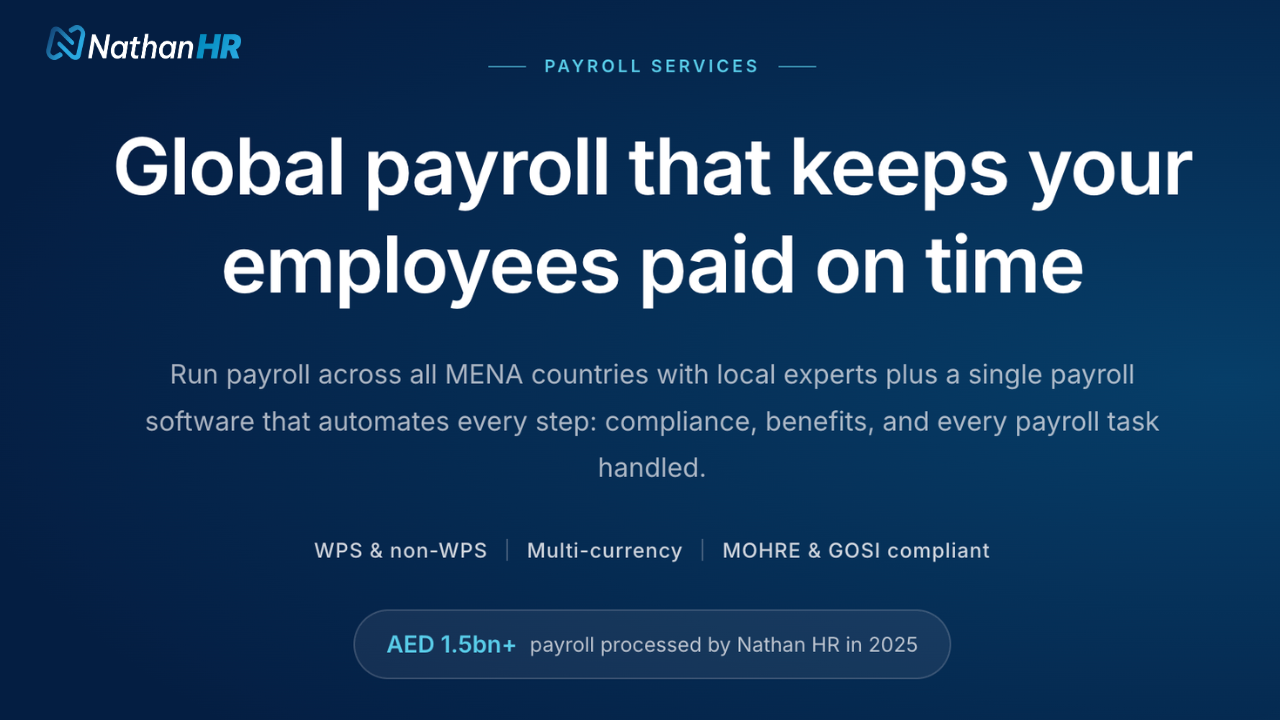
Our payroll services in the UAE include WPS and non-WPS salary processing, claims and reimbursements, end-of-service benefit processing, bilingual payslips and payroll reporting.
Nathan HR’s current Payroll Services page also lists JV files, approval trails and payroll reports among the records produced through the managed payroll service.
For organisations operating through several entities, the service supports multi-entity payroll alongside multi-currency functionality.
Payroll Central supports custom pay structures, multiple currencies and countries, data import and export, alerts and API integration with HR, finance and time-tracking systems.
The agreed scope should document which tasks Nathan HR performs and which responsibilities remain with the employer.
How Nathan HR Payroll Implementation Works
1. Discovery call, data collection and process mapping
The first stage focuses on understanding payroll requirements through data collection and process mapping.
The organisation should use this stage to document employee groups, legal entities, payroll calendars, pay elements, approval roles, reporting requirements and relevant systems.
2. Payroll setup and system configuration
The second stage is payroll setup and system configuration.
The agreed configuration should reflect the requirements established during discovery. Businesses should confirm which entities, pay structures, approval requirements, data formats and system connections form part of the implementation scope.
3. Shadow payroll run and training
The third stage is a shadow payroll run and training.
A shadow run provides an opportunity to compare payroll outputs before independent processing starts. Testing criteria, reconciliation requirements and sign-off responsibilities should be agreed during implementation.
4. Independent payroll run
The fourth stage is the independent payroll run.
Businesses moving from another provider should also assign ownership for historical payroll information, outstanding items and the handover date.
Our guide to switching payroll providers in the UAE covers transition planning in greater depth.
What Should the Recurring Payroll Process Define?
Payroll schedules differ between organisations. Headcount, entity structure, variable pay, attendance inputs, approvals and banking arrangements can all affect the operating process.
The employer and payroll provider should document responsibility for each recurring stage.
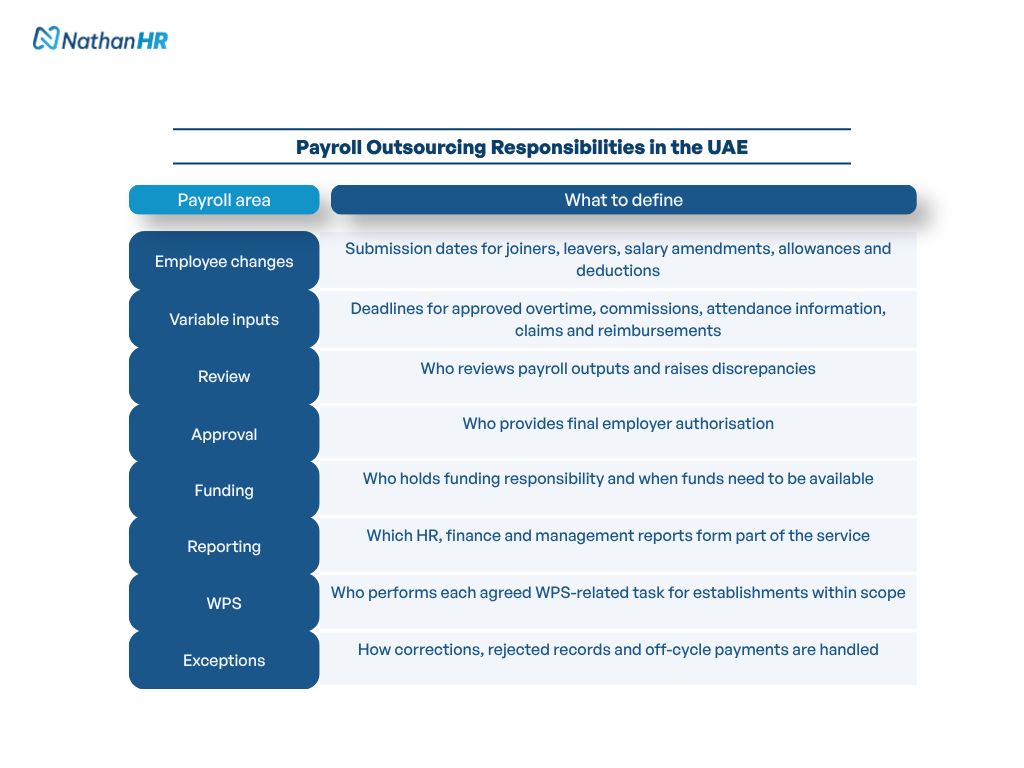
This division of responsibilities should be documented in the service scope and payroll calendar.
How WPS Fits Into UAE Payroll Processing
The Wages Protection System is an important part of payroll administration for employers within its scope.
Current UAE Government guidance on salary and wage payments states that establishments registered with the Ministry of Human Resources and Emiratisation must pay employees’ wages on the due date through WPS, subject to the worker and employer exclusions set out in the current rules.
The guidance cites Ministerial Resolution No. 340 of 2026 concerning the Wage Protection System. Under the current framework, salaries for the previous month are due on the first day of each Gregorian month.
The UAE Government also lists categories of workers and employers that are excluded from WPS requirements. Businesses should therefore establish whether the relevant establishment and employee population fall within the system before defining the payroll workflow.
Nathan HR’s Payroll Services page states that our managed service supports WPS and non-WPS salary processing and WPS submissions.
Employment frameworks also differ across the UAE. UAE Government guidance on employment in free zones notes that free-zone employment is governed through the relevant authority framework, while DIFC and ADGM operate independent employment regulatory regimes.
For payroll implementation, the employer and provider should identify the legal entity, employment jurisdiction and wage-payment process that applies to each employee population.
How Payroll Central Supports Payroll Delivery
Payroll depends on information from across HR and finance. Employee records, attendance, leave, approved pay changes and finance data can all contribute to a payroll run.
Nathan HR states that Payroll Central supports API connections with HR, finance and time-tracking systems. The platform also supports data import and export, custom pay structures, multiple currencies and configured alerts.
The method used to exchange information should be confirmed during implementation. The organisation should identify where each payroll input originates, how it reaches payroll and where approved payroll outputs need to go.
For businesses managing employees across several countries, our multi-country payroll guide discusses regional payroll coordination in greater depth.
How End-of-Service Processing Fits Into Payroll
Final payroll can include outstanding wages, approved deductions and end-of-service entitlements.
Nathan HR lists end-of-service benefit processing within our managed payroll service.
For eligible expatriate workers under the traditional gratuity system, UAE Government guidance on end-of-service benefits states that gratuity for full-time foreign workers is calculated using the worker’s last basic salary.
The guidance also states that employers must pay outstanding wages, other entitlements and gratuity within 14 days after termination of the employment contract.
Payroll teams therefore need to identify the employment framework that applies to the worker before processing the relevant entitlement.
What Responsibilities Remain With Your Business?
Payroll outsourcing does not change the identity of the employer in a payroll-only arrangement.
The employer continues to make decisions about employment terms and compensation. It also needs to provide the information required for payroll and maintain appropriate internal approval authority.
The operating model should specify who can authorise salary changes, variable payments, deductions, new joiners, terminations and off-cycle payments.
Funding responsibilities and banking authority should also be documented. Internal contacts should be assigned for payroll inputs, approvals, finance reconciliation and escalations.
For businesses deciding between an internal team and an external provider, our in-house versus outsourced payroll guide compares both models.
What Should You Prepare Before Payroll Implementation?
Preparation should focus on the information required to define and configure the payroll service.
Useful items include:
Employee master data and employment terms;
Salary structures, allowances, deductions and recurring pay elements;
Payroll calendars and pay frequencies;
Legal entity and employment-jurisdiction information;
Historical payroll records required for implementation;
Leave, attendance and time-data sources;
Approval roles and escalation contacts;
Finance coding and reporting requirements;
Details of HR, finance and time systems that need to exchange payroll information; and
Existing WPS arrangements for establishments within scope.
Businesses should also document less frequent events such as bonuses, commissions, retroactive amendments, terminations and off-cycle payments where these form part of their payroll requirements.
Speak to Nathan HR About Payroll Outsourcing
Nathan HR combines managed payroll services with Payroll Central for WPS and non-WPS salary processing, multi-entity payroll, multi-currency and multi-country functionality, reporting, bilingual payslips, end-of-service benefit processing and system integration.
If your organisation is considering payroll outsourcing, speak with our payroll team about your employee population, entities, payroll calendar, reporting requirements and existing systems.
Explore our payroll services in the UAE to review the current service scope and discuss your payroll requirements with Nathan HR.